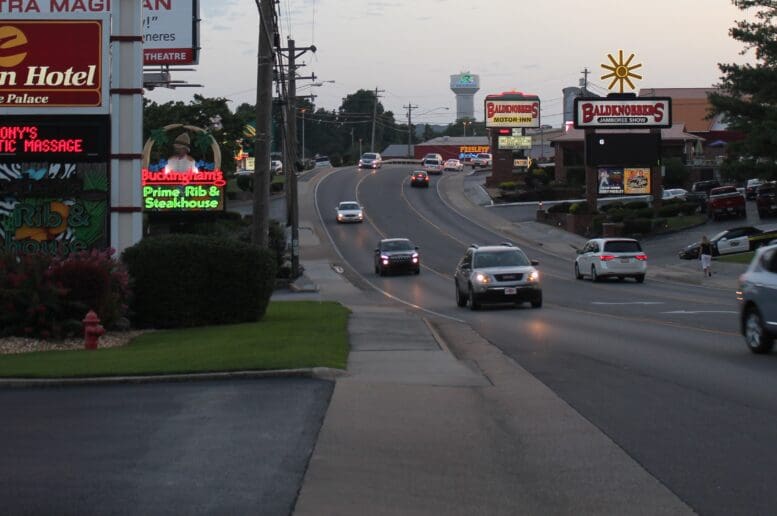
Driving west we hit the twistiest roads of all. We muscled through Ozark County along stomach-flipping slalom courses that make pretzels look straight, through tight curves where Erifnus could see her own back bumper.

Headed toward Branson we hit the Taney County line. Taney County was named for Andrew Jackson’s Chief Justice of the United States Supreme Court, Roger B. Taney, who married the sister of “Star-Spangled Banner” author Francis Scott Key. Taney later delivered the 1857 Supreme Court majority opinion declaring Dred Scott was not a U.S. citizen, and therefore could not sue for his freedom. Taney County also is the backdrop for the movie Winter’s Bone, the chilling tale of meth and death.

We drove circles around beautiful rural Taney County, passing the ghost of Who’d a Tho’t It School near ProTem. We sought Coffin Spring and Dewey Bald, and the tall pine Signal Tree used by Bald Knobbers in Harold Bell Wright’s novel Shepherd of the Hills. We passed Mud Socket and Murder Rock, Trigger Creek and Three Johns School, where there’s no waiting. We found Gobbler’s Knob and looked for Free Jack Spring, named for a freed slave who lived there, and Peg Leg Hollow, named for a Civil War captain’s wooden leg. We searched for Lottie Lawless Hollow, named for a woman who hanged herself there, and Possum Trot—mentioned by Granny Clampett—and Granny Hole on Turkey Creek. No relation.
Driving all of this outback, the stories behind this strange nomenclature would be lost, were it not for Margaret E. Bell, who dutifully recorded these unique appellations and the tales of their creation. It must have been a tedious project, back in 1933. I can’t imagine anybody driving all of these roads to uncover their stories.
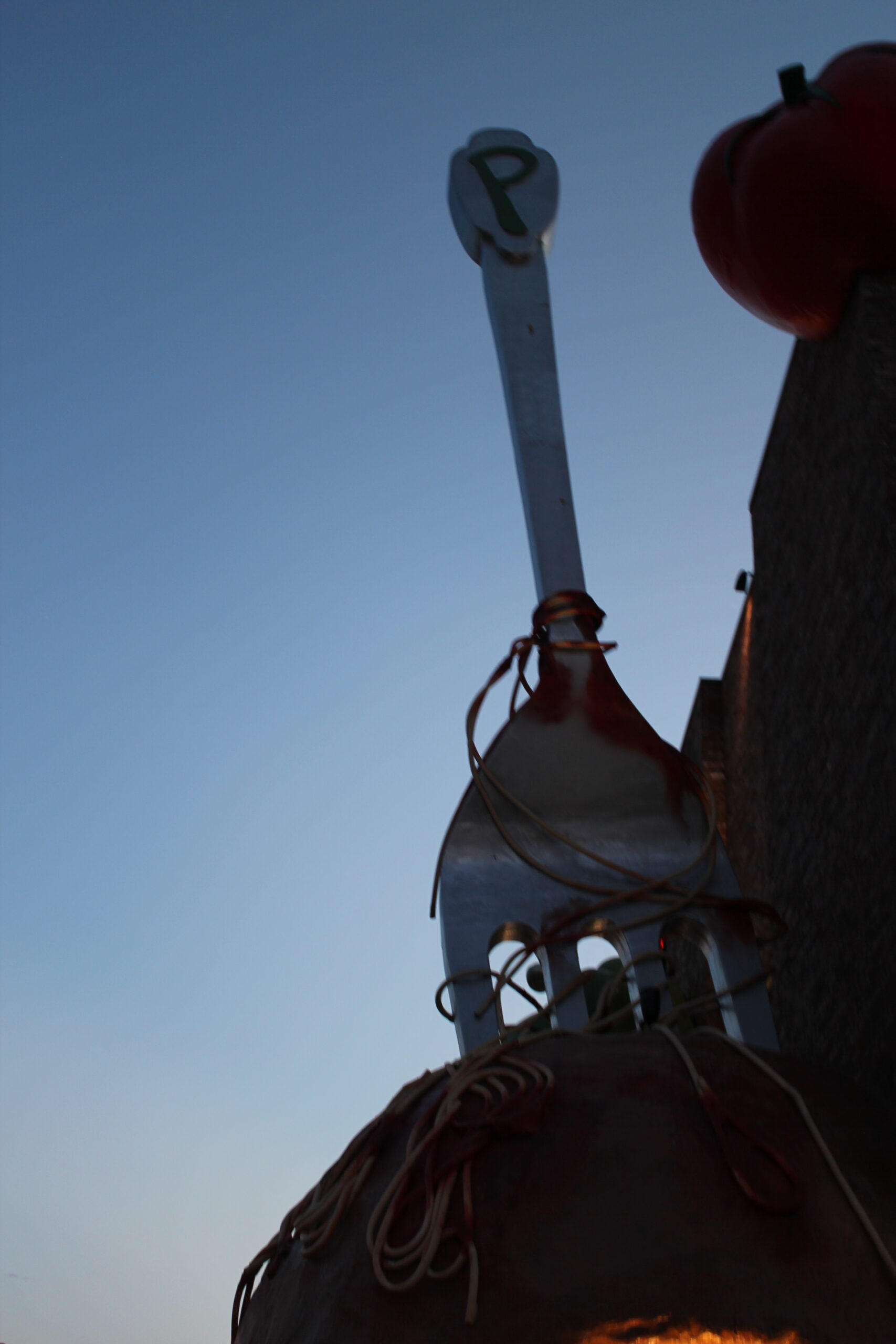
Wrapped in remote obscurity until it reaches Branson, Highway 76 becomes Country 76 Boulevard, the aorta through Branson’s theaters, restaurants, museums, t-shirt shops and go kart tracks. The pressure of eight million tourists on a town of 12,000 made Highway 76 the single most continuous traffic jam this side of LA’s Carmageddon, finally forcing the highway department to perform bypass surgery. If you’re in a hurry to traverse Branson, run the cat roads, the backroad shortcuts. These roads slice through the urban sprawl like slashes from Zorro’s sword. The shortcuts don’t seem to ease the pressure along Country 76 Boulevard.

In this rhinestone capital, unruly behavior is legendary. Even the name Branson was changed in 1902 to Lucia, because folks didn’t like its namesake, early postmaster and reputed Bald Knobber Rube Branson. But the name changed back to Branson in 1908.
The Bald Knobbers, a loose association of unbridled vigilantes, applied a lynch mob brand of justice to accused wrongdoers. In the void of civility after the Civil War, vigilante groups including the Sons of Honor brought accused miscreants to justice. In doing so, they used their own brand of terrorism. “String ’em up!” the vigilantes yelled. “Right back at you,” Missouri’s militia chief George Caleb Bingham said, applying his own brand of terrorism to the Sons of Honor. Proving he was as creative with a Constitution as he was with a paintbrush, Bingham threatened to restore order by bringing in the state militia. The Bald Knobbers ignored Bingham’s threat, until neighbors found out the militia’s cost would be borne by local taxpayers. The angry taxpayers ran the vigilantes out of the county, thus avoiding a tax hike.
Share this Post